Every Client is a Muse
Loving Faces and Seeing God

Venus of the Mind is a weekly publication about beauty, culture, and magic of the everyday.
Monthly Missive: Every Client is a Muse
Loving Faces and Seeing God
Read Time: 6 Mins

And if only everybody could realize this! But it cannot be explained. There is no way of telling people that they are all walking around shining like the sun.
_Reverend Thomas Merton, Conjectures of a Guilty Bystander
The Painter
Once upon a time I had a crush on a painter. She taught me how to see faces, beginning with my own. Regrettably, I’ve yet to figure out how to translate what I see via pencil onto paper; I’m certainly nowhere near brush to canvas yet. If I hadn’t met her, this painter with a penchant for oil and gouache, I may have never returned to the trade of esthetics. After all, I thought I’d left the industry for good back in 2018.
She introduced me to John Berger’s writing and we both encountered Sally Mann’s photography together. Between shared turns developing in the darkroom she would talk me through her perceptions of light and shadow. I would talk her through my perceptions of written versus spoken syntax. I like to think that just as she taught me to see better, maybe I taught her to hear better. She lived in lines, shapes, and colors. I lived in sound, language, and history. Time shared with her was like weaving two worlds together and telling a newer better story.
It snuck up on me, the fact that I loved her. Much like Adam in Eden, when I’d realized what I’d done — accidentally fallen in love with her — I was afraid. But later, perhaps like Lilith in Eden, I became curious. If loving her felt like birthing a brand new Earth (sometimes painful, always perfect) what would it feel like to reflect that love back onto myself? What could my life be like if I learned to see myself as I saw her? If looking at her felt like seeing God, was a piece of the Divine reflected in me too?
Saint Peter
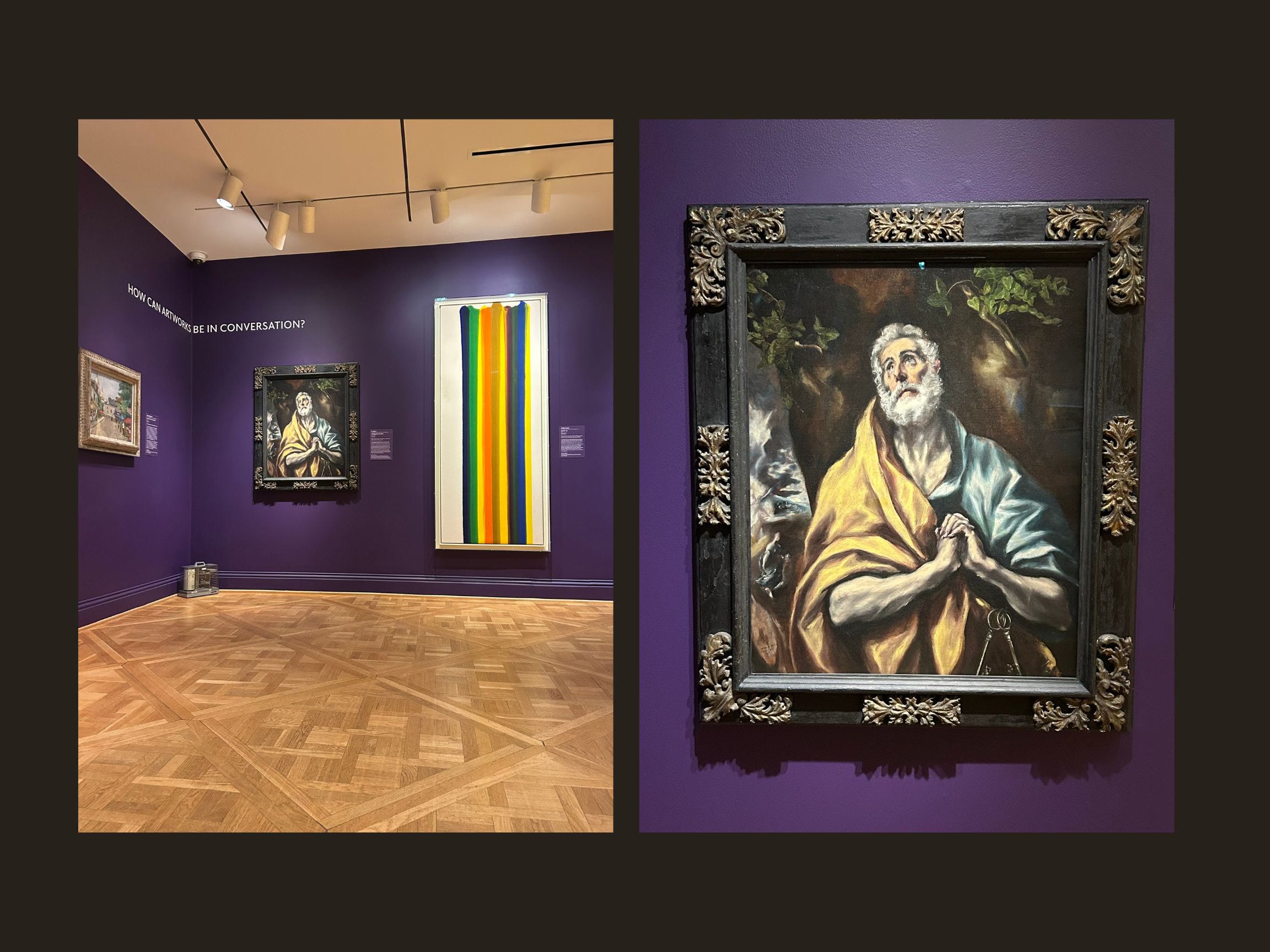
Doménikos Theotokópoulos painted The Repentant Saint Peter over four centuries ago. Duncan Phillips acquired the work in 1922. It took my breath away in 2026.
On January 4 of this year, I went to The Phillips Collection intent on seeing something else entirely when there was Saint Peter, waiting in the main lobby. El Greco iterated several paintings of this moment in Saint Peter’s arc so that while I’ve always admired printed reproductions, I’d never clocked that there was version just a car-ride away from me in D.C. The way that I stayed with that painting for what felt like hours but never enough. It must’ve looked like I was planning a heist. I shed some tears from the surprise.
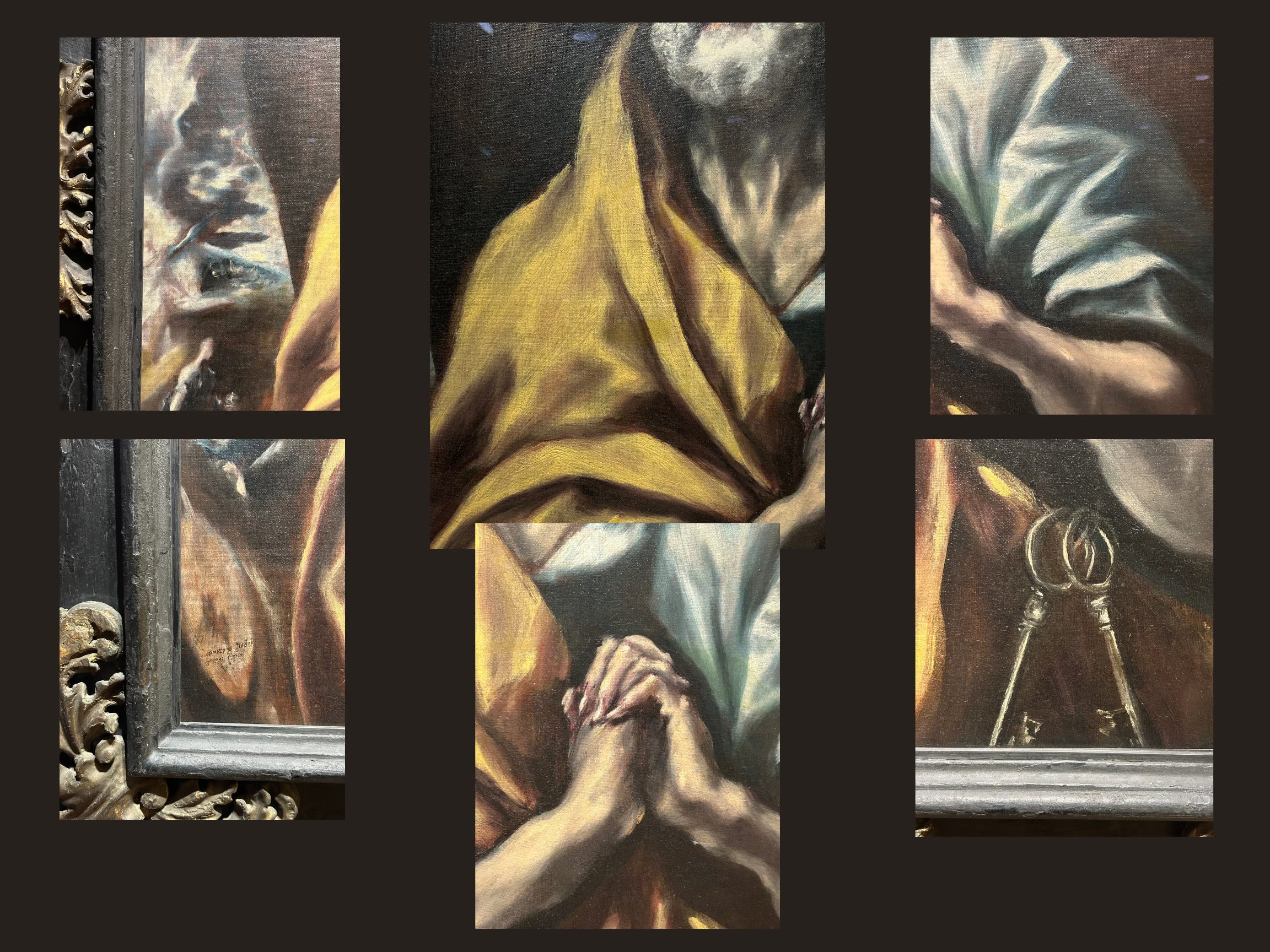
In person it’s mesmerizing the way light falls all around Peter but also seems to be coming through him. El Greco summons a feature of light and a sentiment of anguish, suffusing the two throughout Peter’s skin and clothes. Gaze long enough and you can hear the clasp of Peter’s keys as he shuffles around in prayer, pleading, promising. Never again will he deny his friend who is also his God. His body is strained. The tension in his neck exaggerated by the telltale elongated Greco-stylized proportions that are characteristic of the artist.
Draped in a golden yellow plus a vibrant blue — a notoriously difficult pigment to acquire at the time — reminiscent of the blue often reserved for the Virgin Mary, El Greco has wrapped Peter in colors that narrate his bold cowardice and his future redemption/ascension. God is out of frame yet heard loud and clear because the light speaks of eternity. Notice how it mainly pours down from the top left but also seems to flicker across all four corners of the painting, flashing through swaths of darkness. Holiness bursts out of the shadows, evoking an eerie solemnity. Heaven can only exist if hell too is a place. Here is Peter longing for one while remembering the other.
That chilly January day in D.C. I looked at Peter and I saw myself. Remembering all the parts of me I’d denied because it felt safer in the moment, only to later feel like I couldn’t breathe. Grateful that I no longer lived like that, elated to be free.
God is Everywhere
Alice Walker references Van Gogh in her essay, “Saving the Life that is Your Own: The Importance of Models in an Artist’s Life.” She opens her piece noting how the painter once lamented in a letter while interned away that he was languishing due to a shortage of models.
People need people. Figurative artists understand this. What good is a refined studio practice and a distinct painterly vision without a living model to map memory from? I believe it’s the same for facialists. All the knowledge of anatomy and physiology; an understanding of ingredient chemistry; advanced techniques of tissue manipulation. What good is any of that without a face to care for? Both professions demand a devotion to attention before arriving at the desired result. One summons light to canvas. The other summons light to skin.
In doing bodywork, my labor is at the intersection of science, beauty, and soul. Perhaps it was inevitable for me to embody the profession this way. The naturalist in me, melded into the aesthete, folded into the pastor’s kid.
Life is both long and short, enduring and ephemeral. I do not know how long I will continue to labor in the treatment room. There are so many more worlds of creativity to explore beyond esthetics. It’s the eternal challenge of an active mind. I’ve only just started my own business but I’m already thinking about its next iteration.
For now, I stay. Because between the glimmers and shadows that make each person unique, every client brings a piece of God with them.
Every client is a muse.